Why EV design raises the bar for threaded joints
According to the International Energy Agency (IEA), global electric-car sales grew 20% in 2025 to exceed 20 million units, about one-quarter of all new cars sold worldwide.
Battery packs and electric motors add mass, and the U.S. Department of Energy notes that lightweight materials can offset it, improving efficiency and range. That expands the use of advanced high-strength steel, aluminum, magnesium, polymers, and composites. It also makes joining more demanding: DOE research identifies joining and corrosion prevention as development areas, including the need to mitigate galvanic corrosion when magnesium, aluminum and special alloys are joined to dissimilar materials.
The implication is that a mixed-material joint must be engineered as a system. Material pairing, interface design, coatings, installation process, environment, and validation method all matter, and no single fastener feature resolves all of them.
What should a thread-locking feature do?
At Tectorius, we see this shift promoting engineers to ask more of a locking feature than anti-loosing alone. Within that system, a thread-locking feature has a focused role: helping resist unintended loosening while keeping the connection removable where service access is needed. Engineers typically weigh five questions:
1. How much thread coverage is appropriate?
2. Does the joint need sealing as well as locking?
3. Will the fastener be removed and reinstalled?
4. What fluids, temperatures, and corrosion exposure will it see?
5. How will the format and character of the threadlocker affect assembly?
What is Tec-Lok™ 100 Series?
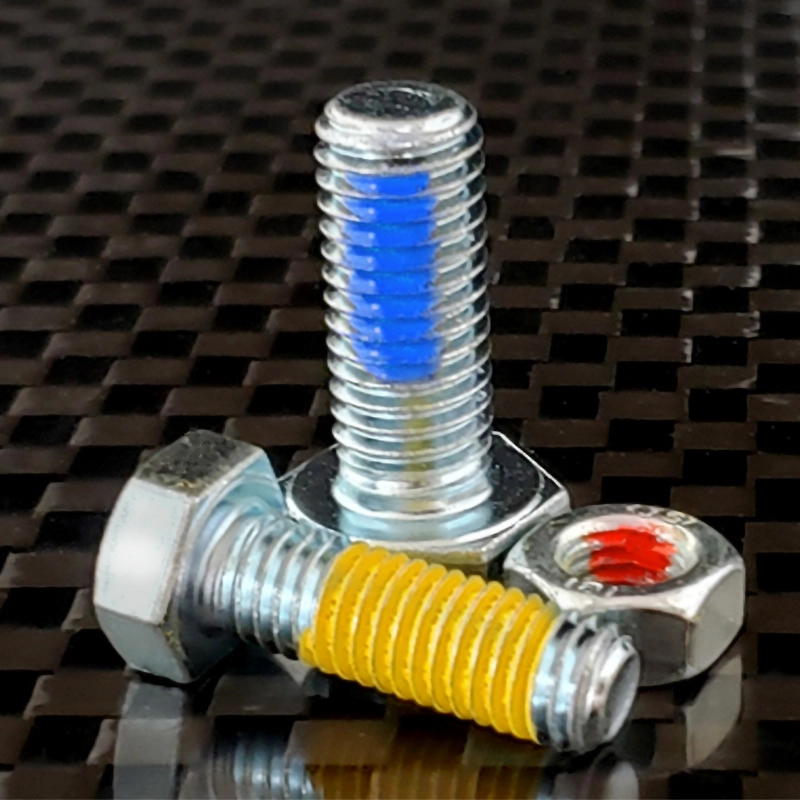
Tec-Lok™ 100 Series is a process-applied Nylon locking patch on the threaded portion of a fastener, designed to lock and seal threaded connections while keeping fasteners serviceable and removable. It is a general, passive thread-locking solution for automotive and industrial fasteners and the properties below should be evaluated against each application's own requirements.
.png)
Additional properties: Shore D hardness 70–80 (ASTM D2240); dielectric strength 800–1,200 volts/mil at 10 mil (ASTM D149); Taber abrasion 10–18 mg loss (ASTM D4060); direct impact 160 in-lb at 10 mil (MPTM 0002). Dielectric and abrasion values vary by color.
Using the data precisely
These are material-level values. Each assembly system includes a multitude of variables. Listed property values do not replace validation of the actual joint.
• Clamp-load retention, torque-tension behavior, vibration performance, and corrosion behavior must be tested on the real fastener, mating component, and materials.
• The 15-cycle rating describes the locking patch, not unlimited reuse of a complete joint. Reuse criteria should account for thread condition, prevailing torque, and joint design.
• Dielectric strength of the coating is not a high-voltage isolation rating for an assembly.
• ASTM B117 salt-spray results do not replace corrosion validation of a mixed-material joint.
• A colored patch is an identification aid, not proof of correct installation or joint performance.
For best results, specify the locking feature, fastener finish, application method, and quality plan together and early.
What to define before specifying a nylon locking patch
A locking patch performs best when the requirements are stated up front. If you are evaluating Tec-Lok™ 100 Series, it helps to have the following information ready:
• Fastener: size, thread type, base material, and plating or finish
• Mating component: material and thread condition
• Coverage: required patch coverage angle (90° to 360°), length, and position
• Function: locking only, or locking and sealing, NVH, dielectric resistance, etc.
• Service requirements: expected number of removals and reinstallations
• Environment: fluids, temperature range, and corrosion exposure
• Process: powdered or liquid grade, and the intended application method
• Identification: whether color coding is needed for part or grade identification
Defining these early helps narrow the grade, coverage, and application route, and it clarifies what validation testing the joint will need.
In summary
Mixed-material design, in EVs and in other lightweight assemblies, is a reminder that a threaded joint is more than a fastener that stays tight. Locking, sealing, serviceability, environment, and manufacturing process all need to be considered together.
Tec-Lok™ 100 Series is a general thread-locking solution for fasteners that must resist unintended loosening and remain serviceable and removable. It is not an EV-specific product. Its suitability for any application should be confirmed through testing on the actual joint.
Sources: International Energy Agency (IEA), Global EV Outlook 2026; U.S. Department of Energy, Lightweight Materials for Cars and Trucks; U.S. DOE Vehicle Technologies Office, Overview of Joining Activities in Lightweighting Materials; Tectorius, Tec-Lok™ 100 Series Technical Data Sheet.
Looking for a solution? We can help.
Our experts are here to learn more about your need.
.png)



.svg)