Complex joint designs often require more than mechanical hardware alone to overcome assembly challenges like access limitations, part retention, and vibration wear. Tectorius® bridges mechanical and chemical fastening with hybrid polymer solutions like Tec-U-Seal™ and Tec-Stay™ Minutefix™. By combining formed-in-place sealing resins with instant UV-curing technology, these multifunctional materials capture hardware, seal joints under the bolt head, and hold sub-assemblies in place, streamlining assembly lines and boosting joint reliability.
When designing new, innovative componentry or sub-assemblies, one must eventually consider the seemingly ordinary topic of attachments. More often than not, all the parts that comprise the assembly can be brought together and held in place with all the usual suspects: screws, bolts, pins, clips and the like. This practice is all well and good until one encounters the dreaded exception. The exception can be a situation where conventional hardware simply will not work on its own. We frequently hit this bump-in-the-road for the same half dozen reasons such as: no viable access, a poor anchoring site, incompatible process steps, poor geometry, costing or the “due to a last minute design change we did not properly consider the attachment point, but now it’s too late to modify the tooling so we had better figure out something fast”-engineering change .
Complicated situations don’t always require complicated answers, they may only need more than one; a multidimensional approach or, so to speak, a ‘composite’ solution. The pecking order for attachment options includes a multitude of mechanical choices, primarily because they are tangible, easy to see and understand. Only once this array of choices is exhausted, either by mechanical rationale or cost, do we look beyond to the less defined, more ethereal options of reactive resins and related materials.
Not always considered is the fact that mechanical and chemical attachment techniques need not be regarded as mutually exclusive. Often the optimum outcome can be accomplished by bringing together the best attributes of multiple materials into one item.
Anchoring systems used in concrete or masonry applications have long looked to epoxy products to enhance the performance of the imbedded anchor. Although the anchor itself is intended to carry the load, the epoxy fortifies the surrounding concrete, dampens vibration, prevents water intrusion and prevents torsional shifts; ultimately providing a more durable, long lasting connection.
Resins and polymers can be ideal complements to metal components in joint designs. Threadlocking adhesives have been commonplace for many decades as a means of securing bolts and screws. In more recent years, the use of new resins has expanded the possibilities for single component fasteners to perform multiple added functions, while doing their primary job of securing a joint.
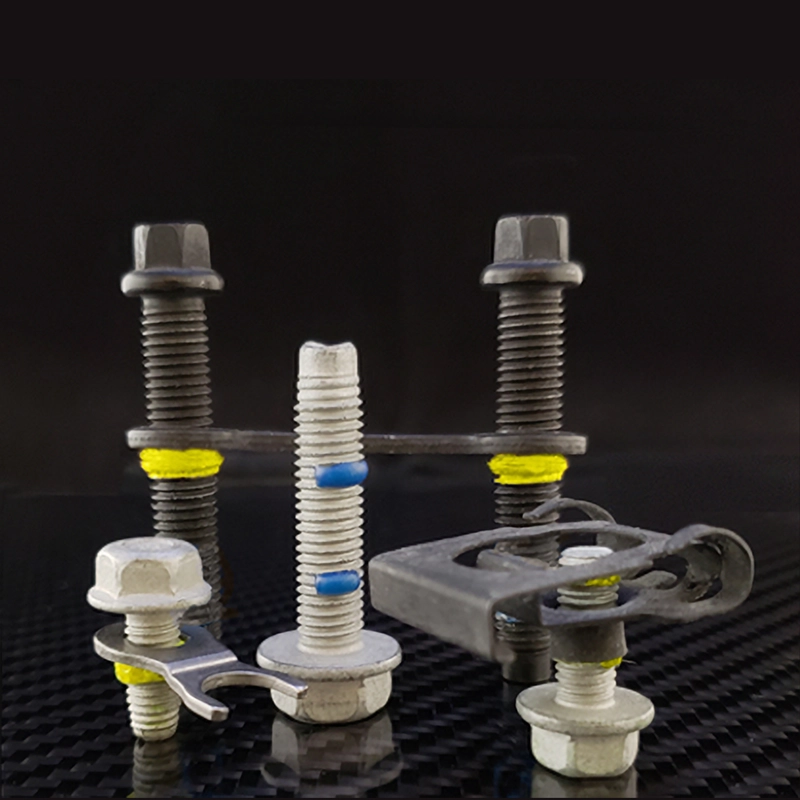
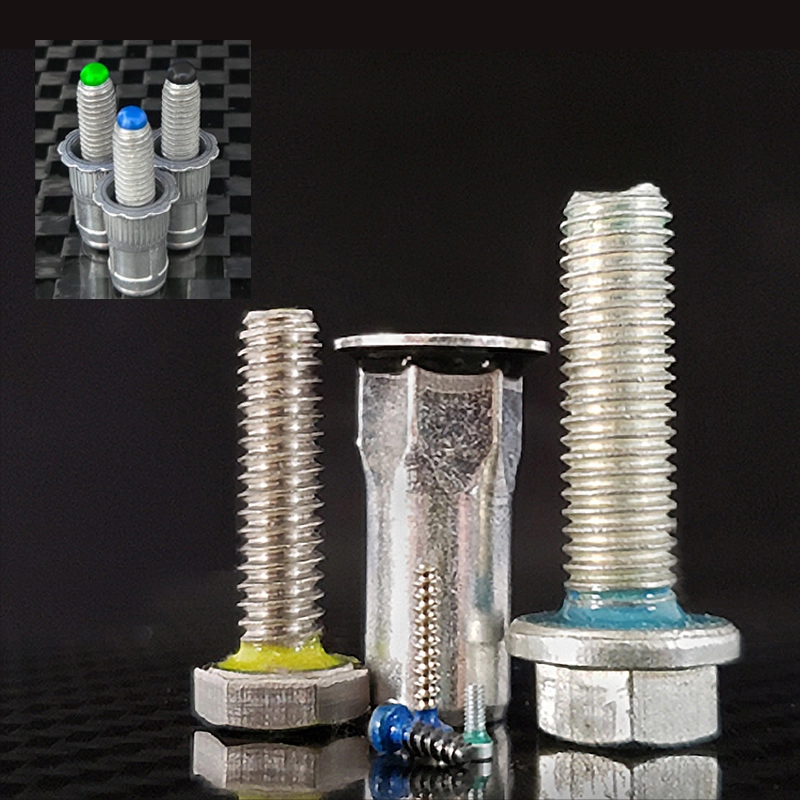
One example includes Tectorius® Tec-U-Seal™, a formed-in-place polymeric material which is positioned under the head of common bolts and screws, used to seal, cushion, or retain parts in multi-staged assembly. Tectorius® Tec-U-Seal™ adds reliability, corrosion prevention, diminishes part numbers and streamlines the assembly process. Tectorius® Tec-U-Seal™ brand encompasses a number of different product grades for a wide range of application types.
Retaining by use of resins does not stop at concrete anchors and epoxy. Specialized multifunction resin systems can be modeled to serve a wide range of functions and add versatility to fastening systems. Retaining, anchoring, fixing, fixturing or staking can make huge strides in assembly line efficiency. Precisely placed polymer resins can be designed into processes where they temporarily, semi-permanently or permanently hold parts together while in transit. For example, bolts needing separate accessory parts, such as multiple washers, bushings or spacers, may be held together and staged upstream to speed up assembly. A resin ring affixed to the side of the bolt can hold these accessory parts in place while in transit, making the bolt its own sub-assembly, fully ready to be installed upon arrival.
An almost opposite case can exist where the bolt itself may need to be retained in a receiving hole of a much larger component, such as a valve cover, manifold, chassis or bracket. A well-placed polymer retainer can capture fasteners in a ready-to-drive position.
In other cases, a complex polymer system can replace a metal or plastic retaining clip entirely. Where fixturing implements were once needed to instantaneously hold assemblies in position while adhesives dried or cured, may now be replaced by instant fixture adhesives. Traditional, UV cured instant adhesives have had the drawback of not being able to be cured where light cannot penetrate or where the deposit is too deep for the light to reach the full deposit depth. Tec-Stay™ Minutefix™, a new groundbreaking addition to the Tec-Stay product line, addresses this very challenge.
Often times, processes, adhesives or coatings must be applied to products, such as in electronic components, where extensive time is required for the final article to cure. In many cases, mechanical fixturing is employed to hold parts in limbo, sometimes for days, while the final cure takes place. The Tec-Stay™ Minutefix™ Product Line, is UV cured, allowing for instant bonding, dry to the touch texture and is self-fixturing. Areas that are too thick for the light penetration or, shielded from the light will continue to cure for several hours thereafter, while being held and sealed securely.
Advances in resin systems cleverly coupled with conventional mechanical methods, can greatly expand the engineering and assembly toolkit for product and process optimization.
Looking for a solution? We can help.
Our experts are here to learn more about your need.
.png)



.svg)