Eliminating Window Regulator Rattle in Plastic Automotive Assemblies Without Redesign
Customer Challenge
A leading automotive component manufacturer was receiving complaints about amplified rattling noise originating from within vehicle doors during normal operation.
Root cause analysis identified the source as micro-movement within the window regulator pulley assembly, where hard plastic components were not interfacing tightly enough to prevent vibration.
The persistent noise degraded perceived vehicle quality and presented a direct customer satisfaction risk that required resolution without delay.
Because the regulator assembly was constructed entirely of plastic, conventional anaerobic threadlockers and structural adhesives posed unacceptable risks of chemical incompatibility, stress-cracking, or surface degradation.
Customer Requirements
Vibration Mitigation: Stabilize the component interface within the pulley assembly to eliminate vibration-induced noise under real-world operating conditions.
Material Compatibility: Ensure full chemical compatibility with engineered plastic substrates, with no risk of degradation, brittleness, or surface damage over the product lifecycle.
Design Preservation: Resolve the issue without tooling changes, part redesigns, or material substitutions to protect existing capital investment and production timelines.
Manufacturing Practicality: Deploy the solution rapidly within the existing production process, with minimal training or workflow disruption.
Tectorius Solution
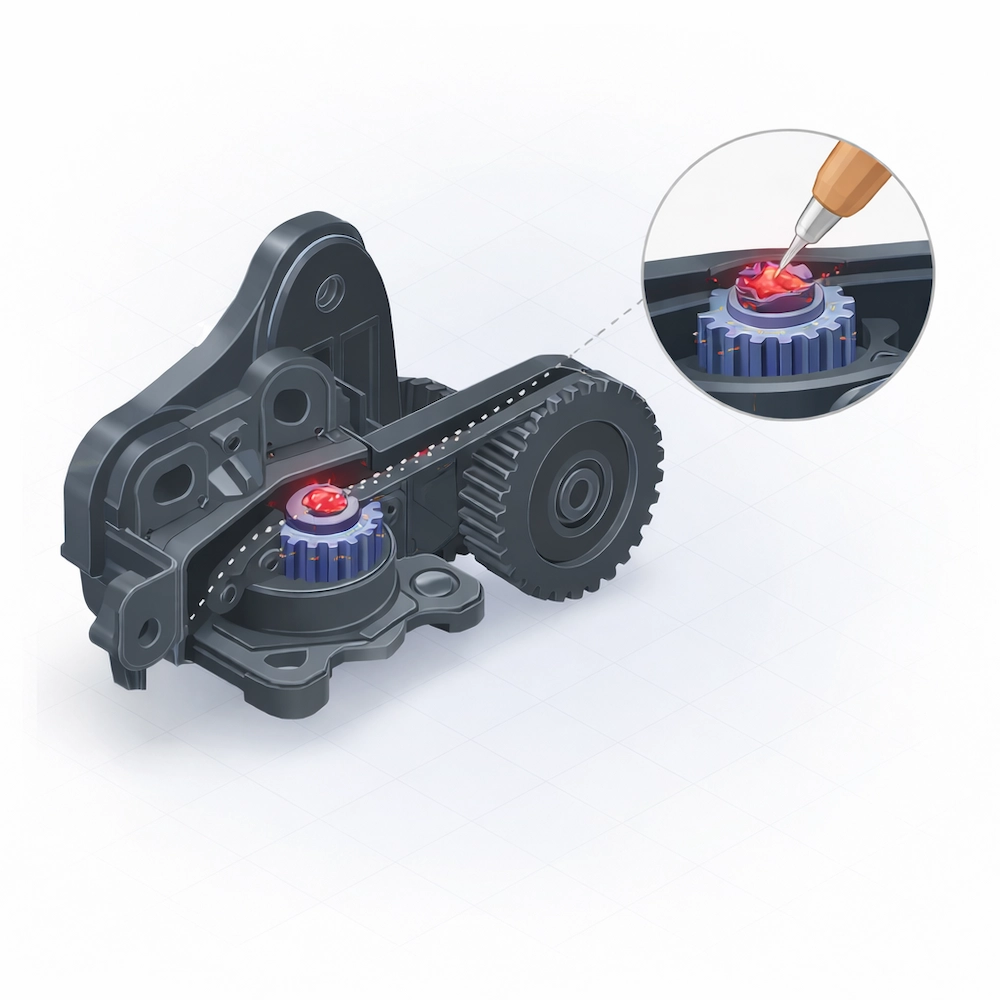
Traditionally, thread lockers are only used on threaded fasteners. Although there are thousands of scenarios where Vibra-Stop® has effectively performed as a traditional thread locker, its unique capabilities can be expanded beyond that traditional use. After evaluating the regulator assembly and characterizing its vibration behavior, Tectorius engineers identified just such an opportunity recommending Vibra-Stop®, a non-anaerobic, polymer-based coating, for direct application to the gear spline in an entirely non-fastener context.
In this application, Vibra-Stop® functioned as a resilient interface layer between mating plastic parts. The material filled microscopic gaps between components, absorbing vibration energy and eliminating the micro-movement responsible for audible rattling.
Unlike anaerobic threadlockers, which can embrittle plastic substrates or cause stress-cracking over time, Vibra-Stop® remains flexible after curing. This inherent resilience allows it to absorb dynamic loads without damaging surrounding surfaces making it particularly well suited for all-plastic assemblies where material compatibility is non-negotiable.
The solution required no changes to the existing manufacturing process. A controlled application of Vibra-Stop® to the spline interface resolved the issue immediately, allowing the manufacturer to avoid the significant cost and lead time associated with a full regulator redesign.
Since integrating Vibra-Stop® into the assembly process, the manufacturer has achieved stable, quiet pulley performance across production, supporting measurably improved perceived vehicle quality without altering a single component in the original design.