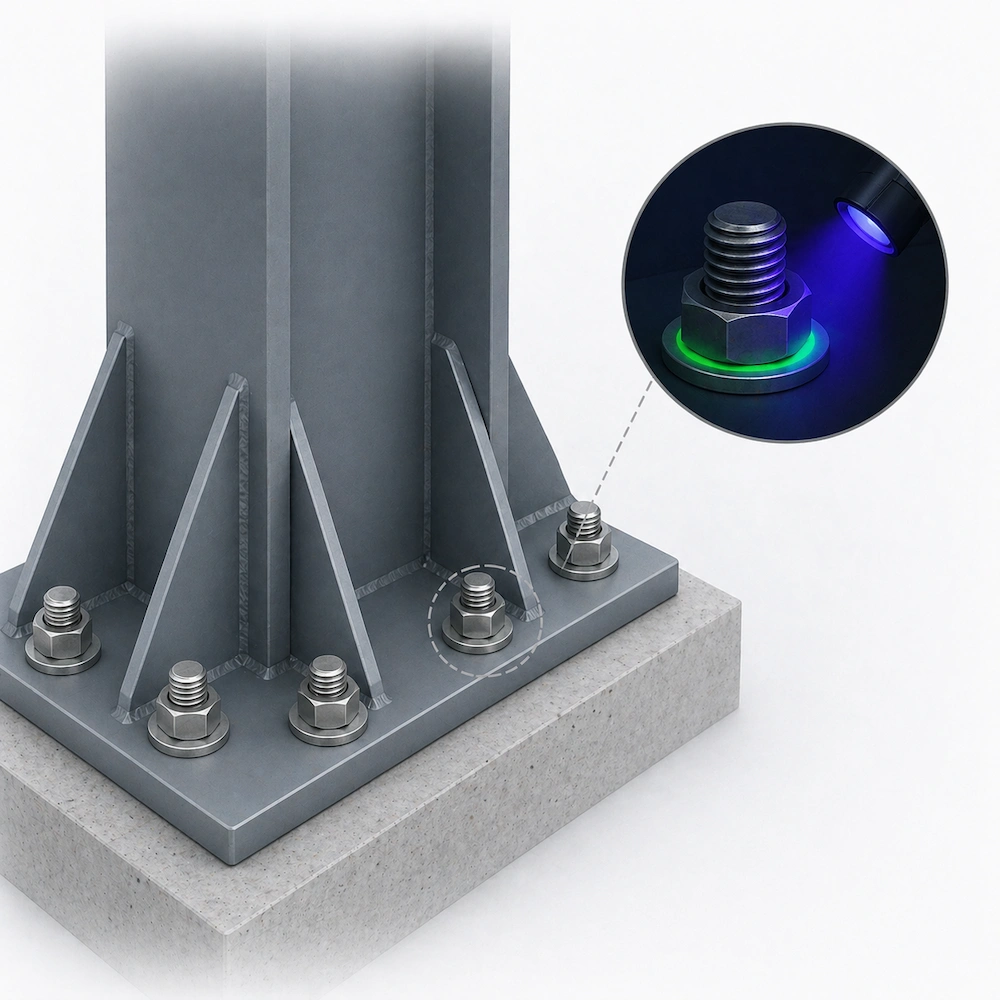
Visual Clamp Load Verification for Critical Structural and Bridge Fastener Assemblies
Customer Challenge
In safety-critical structural applications such as bridge and building assembly, traditional fastening methods provide no direct confirmation that bolts have achieved the required clamp load. This introduces uncertainty into both assembly quality and long-term structural integrity.
Engineering and construction teams required a reliable, field-practical method of verifying that each fastener had been tightened to specification — including in dark or confined installation environments where standard visual inspection is difficult.
Customer Requirements
Clamp Load Verification: Provide unambiguous, per-fastener confirmation that the required joint clamp load has been achieved at the point of installation.
Low-Light and Confined-Space Inspectability: Ensure the indicating feature remains readable in dark or restricted-access installation environments without additional instrumentation.
Assembly Consistency: Deliver a repeatable, operator-independent verification method. In high-stakes structural applications, under-tightened joints carry serious safety consequences, so consistency cannot depend on individual technique.
Tectorius Solution
Tectorius partnered with a leading washer manufacturer to pair Tec-U-Seal™ 587 with their self-indicating washer system, ViewTite®. As the joint reaches its required clamp load, compression releases a colored indicating compound around the washer, giving an immediate, unambiguous visual signal that the bolt has been tightened to specification.
Tec-U-Seal™ 587's proprietary coloration formula fluoresces under UV (black light) exposure, extending inspectability into dark and confined installation environments where standard visual verification is impractical.
By combining Tectorius's engineered polymer coating with ViewTite's load-indicating washer technology, the system delivers per-joint clamp load assurance for bridge, structural, and other safety-critical fastener applications — reducing the risk of under-tightened assemblies and giving construction teams verifiable confirmation at every fastener location.